What is an aircon gas top-up?
Is your aircon running all day but the room still feels warm? A low refrigerant charge could be the reason. An aircon gas top-up adds refrigerant so the system can carry heat out of your room again.
We work on R22 refrigerant, R410A refrigerant and R32 refrigerant systems. Every top-up includes a leak check and a pressure test, and starts from S$80.
The three gases run at different pressures. One Singapore service guide from Uncle7 Aircon lists typical suction pressure at about 65 to 75 PSI for R22, 120 to 135 PSI for R410A and 115 to 130 PSI for R32.
| Refrigerant | Typical suction pressure | Where you’ll usually find it |
|---|---|---|
| R22 | About 65 to 75 PSI | Older units |
| R410A | About 120 to 135 PSI | Many mid-age inverter and non-inverter units |
| R32 | About 115 to 130 PSI | Newer inverter units |
Those figures shift with room and outdoor temperature. So we always read your unit’s pressure against its own specification, not a generic number.
Why a top-up alone is not enough
Refrigerant runs in a sealed loop between the indoor coil and the outdoor unit, through the copper piping. It does not burn off or get used up. If the charge is low, it has leaked out somewhere.
That is why we always check before adding gas. A top-up without fixing the leak only lasts until the gas escapes again, which might be weeks or months. You pay twice and the unit keeps running poorly in between.
Singapore aircon guide Snowflake Aircon makes the same point: a sealed system has no routine top-up schedule. If cooling drops again after a top-up, the leak needs tracing.
How we test and top up
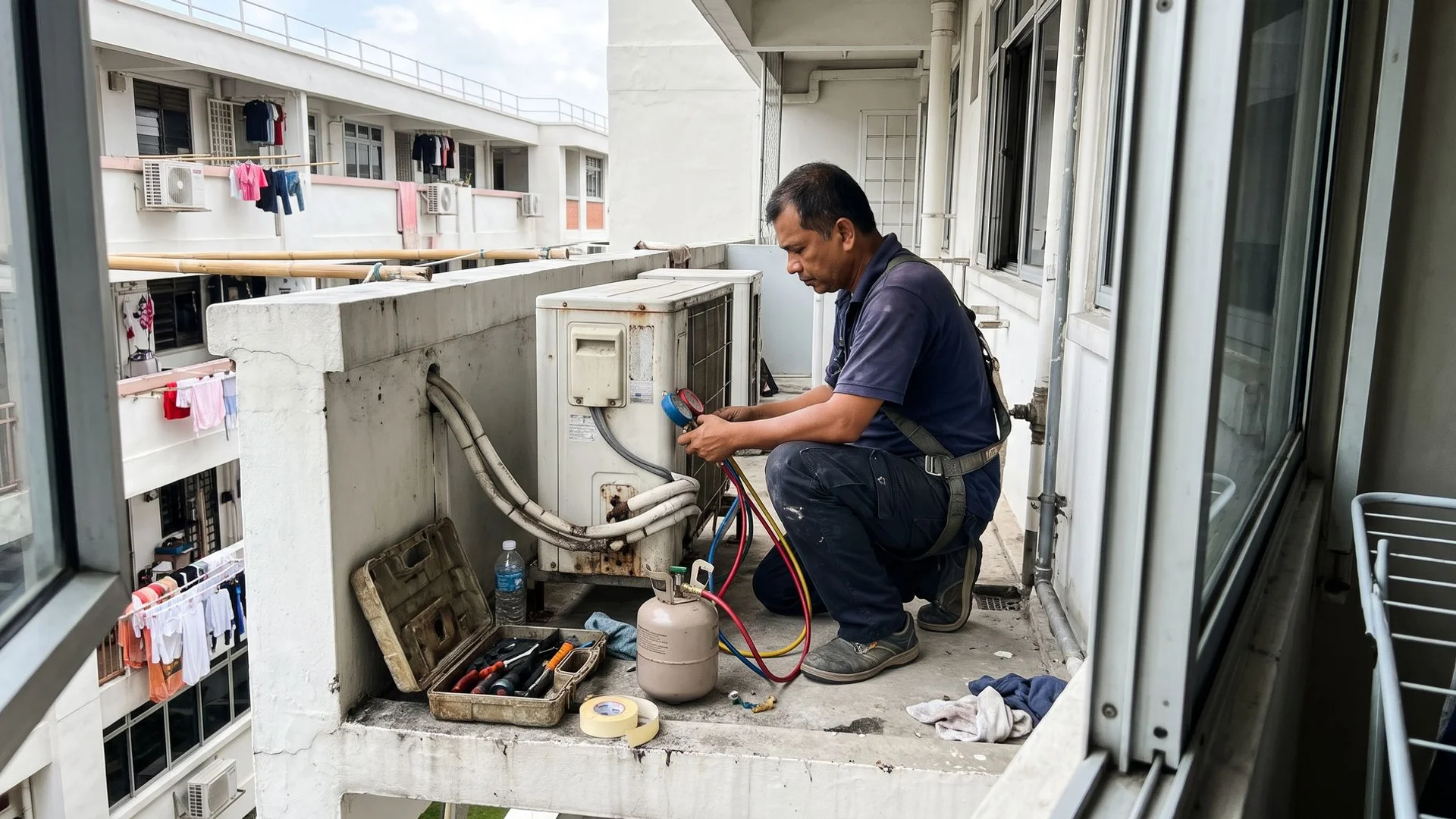
- Pressure test. We connect a gauge manifold to the service port and read the operating pressure, in PSI, against what your unit should run at.
- Leak check. We check each flare nut joint with a soap bubble test. Bubbles show where gas is escaping. For harder leaks, a nitrogen pressure test helps find them.
- Fix the leak. Most leaks are at joints and can be re-flared or tightened. Leak repair is quoted before work.
- Top up. Refrigerant is added through the suction line until pressure is right.
- Test again. We check pressure and outlet temperature once more, and look at both the suction line and the liquid line for icing.
You’ll know the price and the plan before we touch anything beyond the top-up itself. No surprises on the invoice.
Signs your aircon may be low on gas
- Cooling fades slowly over weeks or months
- A hissing sound near the pipes or indoor unit
- Ice or frost on the copper pipe or coil
- The compressor runs non-stop and never cuts off
- Oily marks at pipe joints, where refrigerant oil escapes with the gas
That oily film is a useful clue. Snowflake Aircon notes that the gas evaporates but the oil stays behind, so check the flare nuts and the insulation near the joints.
Low gas is not the only cause of a warm aircon. Dirty coils (the kind regular aircon servicing in Jurong keeps in check), a failed capacitor or a faulty sensor give similar symptoms. Ice can also come from a blocked filter or a faulty expansion valve, so one sign on its own does not prove a leak.
If you are not sure, book our aircon not cold repair and we will find the actual cause first.
Multi-split and inverter systems
On a multi-split set-up, several fan coils share one outdoor unit and one refrigerant charge. A leak on one line affects every room. That matters if you have 2 to 4 rooms cooled from a single compressor.
Newer inverter units mostly run on R32. LG’s Singapore R32 multi-split range, for example, connects up to 3 or 4 indoor units to a single outdoor unit, depending on the model.
Our guide to servicing inverter multi-split systems explains how these systems differ. Not sure which gas your unit uses? Send us a photo of the nameplate and we’ll tell you what to expect before we visit.